Why a toothbrush is not enough
Even with excellent technique, a toothbrush mainly cleans the visible surfaces of the teeth: the outer, inner and chewing surfaces. The surfaces between two teeth, pressed tightly together, remain largely out of reach.
Yet these are exactly the areas where plaque settles most easily. Many cavities form there, often invisible to the naked eye, and it is also where the gums become inflamed first. Gums that bleed between two teeth are often the first sign of gingivitis.
Cleaning between your teeth once a day therefore completes your brushing. The evening, before or after brushing, is a good time to make it a habit.
Floss, interdental brushes, water flosser: what is the difference?
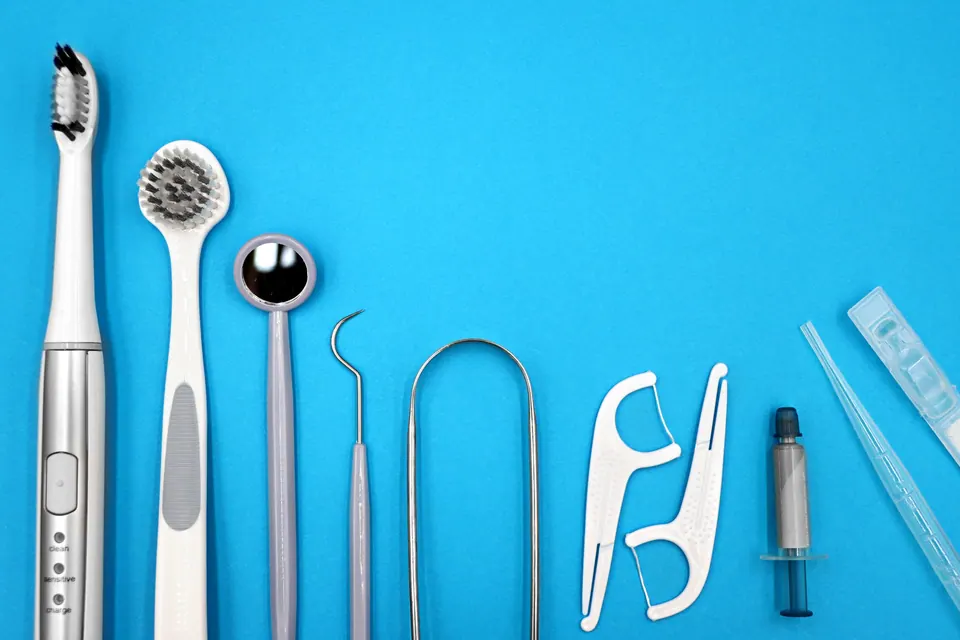
There are several tools, and the best one is the one that fits your spaces and that you will actually use.
- Dental floss (or dental tape, which is flatter) works well for very tight teeth where no brush will fit. It takes a little practice. Disposable floss holders can make it easier to reach the back teeth.
- Interdental brushes are small cylindrical or tapered brushes in several sizes. They are often easier to handle and very effective where the spaces allow, for example when the gums have receded.
- A water flosser sends out a pulsing jet of water. It can help dislodge debris, particularly around a brace or implants, and suits people who struggle with floss. It is generally seen as an addition, and does not always remove sticky plaque as well as mechanical cleaning.
Wooden or plastic toothpicks are not a substitute for these tools: used repeatedly and with pressure, they can injure the gums.
How to use dental floss properly
The technique takes just a few days to learn:
- Take about 40 cm of floss and wind most of it around your middle fingers, leaving a few centimetres between them.
- Hold the floss taut between your thumbs and index fingers and ease it gently between two teeth with a back and forth motion, without snapping it onto the gum.
- When you reach the gum, curve the floss into a C shape around the tooth and move it up and down its surface several times, going slightly under the gum line.
- Repeat on the neighbouring tooth, then move to the next space using a clean section of floss.
Do not forget the back of the last molars. If the floss keeps shredding or catching in the same place, tell your dentist: it may point to a cavity, heavy tartar or a filling that needs attention.
Choosing and using interdental brushes
Size is essential. The brush should slide in without forcing while rubbing lightly against both neighbouring teeth. Too thin and it will not clean; too wide and it will irritate the gum. It is common to need two or three different sizes for different areas of the mouth.
To use one:
- insert the brush gently at gum level, at a right angle to the teeth (slightly angled for the back teeth);
- move it in and out a few times without twisting, then remove it;
- rinse it after each space and replace it as soon as the bristles flatten or the wire bends.
Never force a brush into a space that is too narrow: floss is better suited there. Your dentist can try out sizes with you during a scale and clean or a check-up.
Bleeding at first: should you worry?
When you start cleaning between your teeth, it is common for the gums to bleed a little for the first few days. The bleeding is not caused by the floss itself but by gums that are already inflamed by the plaque that has built up there.
With gentle daily cleaning, the bleeding usually eases noticeably within one to two weeks as the inflammation settles. That is a sign the routine is working, not a reason to give it up.
Do see a dentist, however, if:
- the bleeding continues beyond two weeks despite regular cleaning;
- your gums are swollen, painful or receding;
- you notice persistent bad breath or loose teeth.
These signs may indicate deeper involvement of the supporting tissues, which calls for appropriate gum treatment after a thorough assessment.
Braces, implants and bridges: special needs
Some situations make cleaning between the teeth even more important.
- Fixed braces: brackets and wires trap a lot of plaque. Interdental brushes fit under the wire, and floss threaders or floss with a stiffened end help you reach the spaces. A water flosser can be a useful extra.
- Dental implants: an implant cannot decay, but the gum and bone around it can become inflamed if plaque builds up. Use interdental brushes with a coated wire or a dedicated floss, as your dentist advises. Regular follow-up is essential for the long-term health of a dental implant.
- Bridges: you need to clean under the false tooth and around the supporting teeth. A thick floss with a stiffened end, designed for this purpose, slides under the bridge.
At German Dental Clinic in Agdal, periodontics is one of the areas of care: at a check-up, the dentist can show you the tools and techniques that suit your mouth. If you are in Rabat and would like a gum assessment or personal advice, you can book an appointment.
Sources
Frequently asked questions
Should I floss before or after brushing?
Both are fine. Cleaning between your teeth before brushing lets the fluoride toothpaste then reach the spaces you have just cleared, which many professionals recommend. What matters most is doing it carefully every day.
Can flossing push my teeth apart?
No. Used correctly, floss does not create gaps between the teeth. If you feel that gaps are appearing or getting wider, this may be linked to receding gums or gum disease, and it is worth having it checked.
Can a water flosser replace floss or interdental brushes?
Not completely, in most cases. A water flosser helps remove debris and can be very useful with braces or implants, but it is mainly an addition. Your dentist can tell you which combination suits your situation.
Should my children floss?
As soon as two teeth touch, plaque can build up between them. An adult can floss for the child, for example with a floss holder, until they are dexterous enough to do it on their own. The dentist will advise you at the check-up.
The information on this page is general. Only a consultation allows a diagnosis and a suitable treatment plan.