A fair question, a nuanced answer
It is one of the first questions asked in an implant consultation: how long will an implant last? The honest answer is that there is no guaranteed lifespan. An implant that is well integrated into the bone and properly cared for can remain functional for a very long time, sometimes for life. Conversely, a neglected implant, or one placed in unfavourable conditions, can run into complications.
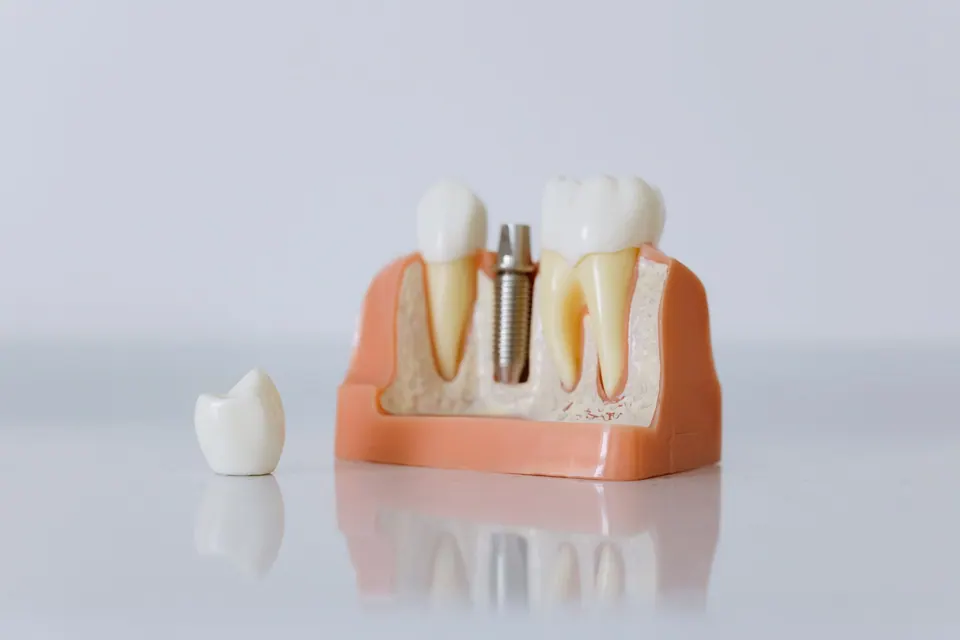
It helps to distinguish two elements. The implant itself, the artificial root placed in the bone, is designed to last. The crown attached to it is subject to wear from chewing, just like a natural tooth: it can wear down, crack or need replacing one day without the implant being at fault.
Understanding the factors behind longevity allows you to play an active part in the success of your treatment. For a full overview of the process, see our dental implant page.
What is decided before placement
An implant's durability starts well before surgery. Several points are assessed during the work-up:
- Bone quantity and quality. An implant needs to be surrounded by enough bone. When the bone has shrunk after an old extraction, rebuilding it may be necessary.
- Gum health. Untreated gum disease around the other teeth increases the risk of inflammation around the implant. It must be brought under control first.
- Planning. The position, angle and length of the implant are chosen according to the future tooth and the forces it will bear. 3D imaging and, in some cases, guided surgery help achieve this precision.
- General health. Diabetes, osteoporosis treated with certain medications, radiotherapy to the area or immunosuppressive treatment all call for a specific assessment.
A thorough work-up cannot guarantee everything, but it reduces avoidable risks. The quality of the crown matters too: a well-fitting restoration, without excess material under the gum and with balanced contacts, is easier to clean and under less strain. That is why the prosthetic part is considered from the planning stage, not as an afterthought.
Smoking and lifestyle habits
Smoking is one of the most studied factors in implant dentistry. It reduces blood flow in the gum, slows healing and encourages inflammation around the implant. Smokers are not excluded from treatment, but the risk of complications is higher. Stopping, or cutting down considerably, at least around the time of placement, is strongly advised.
Other habits play a part too:
- Bruxism (clenching or grinding the teeth, often at night) places heavy forces on the crown and the implant. A protective night guard is then often recommended.
- Biting hard objects (pens, nails, stones, shells) can fracture the ceramic.
- A very sugary diet does not damage the implant itself, but it feeds plaque and weakens the neighbouring teeth.
These points are discussed openly during the consultation, without judgement.
Daily hygiene around the implant
An implant cannot decay, but the gum around it can become inflamed. This is called mucositis when the inflammation affects only the gum, and peri-implantitis when it reaches the bone that supports the implant. The main culprit is bacterial plaque that builds up where the crown meets the gum.
Good daily habits:
- gentle, careful brushing twice a day, paying particular attention to the junction between the crown and the gum;
- cleaning between the teeth with interdental brushes of the right size, or special floss;
- a water flosser as an extra, if your dentist recommends it;
- watching for bleeding: gums that bleed around an implant should be checked.
Your dentist shows you these techniques in your own mouth, because every restoration has a different shape.
Regular professional follow-up
Check-ups are not a formality. They make it possible to check the stability of the implant, the condition of the gum, the occlusion (the way the teeth meet) and, if needed, the bone with an X-ray. A problem spotted early is generally simpler to treat.
Professional scaling, carried out with instruments suited to implant surfaces, removes tartar that brushing cannot. The frequency of appointments is tailored to you: it may be more frequent for people with a history of gum disease.
If inflammation is detected, appropriate gum treatment can be put in place to bring it under control.
Warning signs to look out for
Some symptoms are a reason to see your dentist without waiting for the next check-up:
- bleeding or swelling of the gum around the implant;
- a bad taste or discharge from the gum;
- a crown that moves, a feeling of looseness or a noise when chewing;
- pain when pressing on it;
- a visible crack or chip in the ceramic.
A crown that moves does not necessarily mean the implant is lost: sometimes it is simply a loose retaining screw, which is easy to fix. Only an examination can tell the difference. In Agdal, the German Dental Clinic team can see you for an implant check-up, whether your implants were placed at the practice or elsewhere. Simply book an appointment.
Frequently asked questions
Does a dental implant last a lifetime?
It can, but no lifespan can be guaranteed. Longevity depends on the bone, gum health, smoking, bruxism, hygiene and follow-up. The crown, for its part, can wear and may need replacing one day without the implant being affected.
Can an implant get tooth decay?
No, titanium and ceramic do not decay. However, the gum and bone around the implant can become inflamed if plaque builds up. That is why hygiene and check-ups remain just as important as with natural teeth.
Do I need a special toothpaste or toothbrush?
A soft manual or electric toothbrush is generally suitable, with a low-abrasion toothpaste. Interdental brushes are often essential. Your dentist will tell you which sizes suit the spaces between your teeth during check-ups.
What should I do if my implant crown moves?
See your dentist promptly and avoid putting pressure on it. It is often a loose screw or a crown that needs re-cementing, but only a clinical and X-ray examination can confirm the condition of the implant and the bone.
The information on this page is general. Only a consultation allows a diagnosis and a suitable treatment plan.