The first few hours: let the blood clot form
Placing an implant is a surgical procedure, even when it is done under local anaesthetic and goes smoothly. In the first few hours the aim is simple: allow the blood clot to form, as it protects the wound and starts the healing process.
In practice, after your appointment:
- Keep the gauze the dentist placed in position, biting firmly on it for the time indicated, without removing it every few minutes to check.
- Do not rinse your mouth or spit repeatedly on the day of surgery: this can dislodge the clot.
- Avoid touching the area with your tongue or fingers, and do not use a straw.
- Wait until the anaesthetic has worn off before eating or having hot drinks, so you do not bite your cheek or burn yourself without noticing.
- Rest for the remainder of the day, with your head slightly raised, including when you sleep.
Take any prescribed medication exactly as written on the prescription. If a painkiller has been recommended, it is often more comfortable to take it before the anaesthetic wears off. Do not add other medicines on your own initiative, and tell the dentist about any current treatment, especially blood thinners, before surgery.
Swelling, bleeding and pain: what to expect
Some discomfort is normal after implant placement. How much depends mainly on the extent of the procedure: a single implant in good-quality bone is very different from several implants combined with a bone graft.
- Swelling often appears within hours and usually peaks around the second or third day before gradually going down. Bruising on the cheek is possible, particularly after more extensive surgery.
- Cold helps to limit it: apply an ice pack or cold pack wrapped in a cloth to the outside of your cheek, for about ten minutes at a time with breaks in between, during the first 24 to 48 hours. Never put ice directly on the skin, and do not apply heat to the cheek.
- Slight bleeding is usual on the first day, and your saliva may remain pink-tinged. If the wound bleeds more, place a clean, folded gauze pad over the area and bite on it without letting go for at least twenty minutes.
- Pain is generally moderate and controlled by the prescribed painkillers. It should ease day by day.
What matters is not so much how you feel in the first few days as how things develop: discomfort that is easing is reassuring, whereas pain or swelling that gets worse after a few days is not.
What to eat in the first few days
The right diet protects the surgical site while still letting you eat properly, which also supports healing.
- On the day of surgery, choose soft foods that are lukewarm or cold: yoghurt, fruit purée, lukewarm soup, mashed potato, scrambled eggs, flaked fish.
- Over the following days, gradually return to a more varied diet, chewing on the side opposite the implant.
- For the period you are given, avoid hard, crunchy or sticky foods (nuts, seeds, crisps, very crusty bread) that could press on the wound or get stuck in it, as well as very spicy or very hot dishes.
- Drink enough water, in small sips and without a straw.
If you wear a temporary removable denture, follow your instructions closely: you may be asked not to wear it for a while, or to have it adjusted so that it does not press on the implant.
Careful hygiene without disturbing the wound
A clean mouth reduces the risk of infection, but the surgical site needs a gentle touch.
- From the evening or the next day, brush your other teeth as usual with a soft toothbrush.
- Around the implant, follow the dentist's instructions: brushing directly over the wound and stitches is usually avoided for the first few days, then resumed with a very soft post-surgical toothbrush.
- Mouthwash should only be used if it has been prescribed, from the time indicated, letting it work without vigorous rinsing.
- Do not pull at the stitches. Depending on the type, they are removed at a check-up or dissolve on their own.
A thin whitish layer on the gum over the wound is part of normal healing and should not be scraped off.
Smoking, alcohol, exercise: what is best avoided
Some habits clearly increase the risk of complications.
- Smoking reduces the oxygen reaching the tissues and delays healing. It is one of the factors that can prevent the implant from bonding with the bone and, in the long term, encourages inflammation around implants. Ideally, stop before surgery and do not start again, or at the very least abstain for as long as possible while you heal. Talk to the dentist about it: help to quit is available.
- Alcohol is best avoided for the first few days, not least because it can interact with some prescribed medicines.
- Strenuous exercise, sport and heavy lifting can restart bleeding or increase swelling, so allow yourself a few quiet days.
- Hammams, saunas and very hot baths should be avoided over the same period.
You can often return to calm, desk-based work fairly quickly, depending on the extent of the procedure and how you feel.
Signs that mean you should call the practice
Recovery is straightforward in most cases. Even so, contact the practice without delay, or see our dental emergency page, if you notice:
- heavy bleeding that does not stop despite firm pressure;
- swelling that keeps increasing after the third day, or comes back;
- pain that gets worse instead of better;
- fever, a persistent bad taste or a discharge of pus;
- numbness of the lip, chin or tongue that lasts well beyond the end of the anaesthetic;
- an implant or healing screw that moves or comes loose.
Difficulty breathing or swallowing, or swelling that spreads quickly towards the eye or neck, means you should go straight to a hospital emergency department.
Healing, follow-up and long-term care
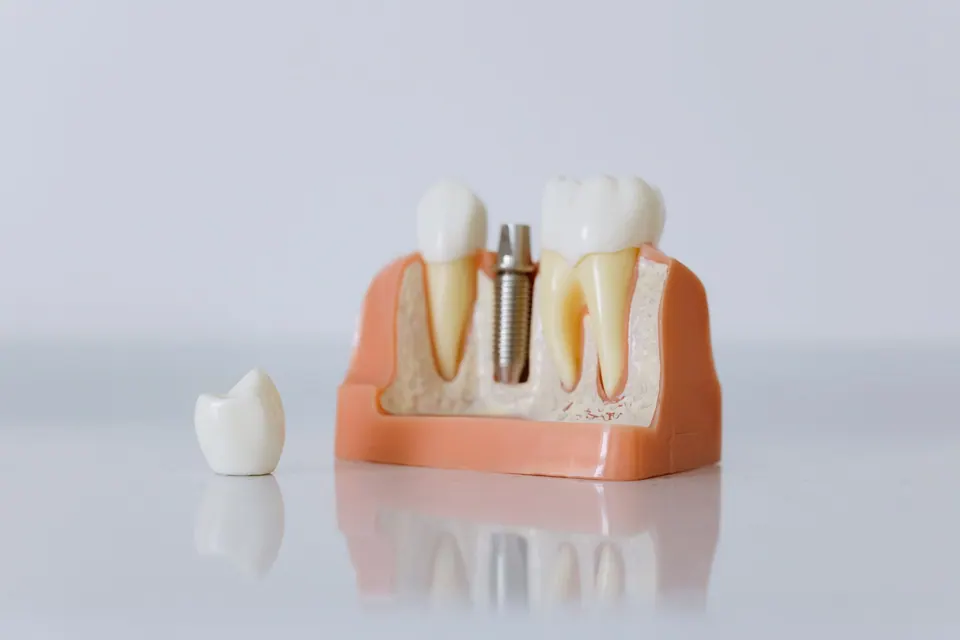
Once the gum has closed, the work continues beneath the surface: the bone gradually remodels against the implant, a process called osseointegration. How long it takes depends on bone quality, the area of the mouth, whether a graft was needed and your general health. It is usually measured in weeks or months, and it is the dentist who decides, after a check-up, when the time is right to fit the final crown.
Follow-up appointments (removing stitches if needed, checking healing, taking an X-ray) are not a formality. At German Dental Clinic in Agdal, they are also used to prepare the restorative stage, for example with a digital impression taken by intraoral scanner.
In the long term an implant cannot decay, but the gum and bone around it can become inflamed (mucositis, then peri-implantitis) if plaque builds up. To look after your dental implant:
- brush twice a day and clean around the implant with suitable interdental brushes;
- keep up regular check-ups and professional cleaning, as often as advised;
- report any bleeding from the gum around the implant;
- mention any clenching or grinding, which may call for a protective night guard.
For a check-up or a question about your healing in Rabat, you can book an appointment.
Sources
Frequently asked questions
How long does swelling last after an implant?
It usually peaks around the second or third day, then gradually goes down over the week. Swelling that is still increasing after the third day, especially with fever or worsening pain, is a reason to call the practice.
Can I smoke after implant surgery?
You are strongly advised not to smoke, at least throughout healing, and ideally not to start again. Smoking slows healing and increases the risk of complications around the implant, in both the short and the long term.
When will I be able to chew normally on the implant side?
That depends on the protocol chosen: whether the implant is buried under the gum, whether it is loaded immediately or later, and whether a graft was needed. The dentist will tell you at each stage what is possible. Until the final crown is fitted, avoid chewing hard foods on that area.
Is it normal to feel discomfort after a week?
Mild tenderness can last a few days, particularly after more extensive surgery. However, pain that is increasing, swelling that comes back or any discharge is not normal and should be reported to the practice promptly.
The information on this page is general. Only a consultation allows a diagnosis and a suitable treatment plan.