How does a telescopic denture work?
The name comes from the principle of a telescope, whose tubes slide into one another. Here, two crowns fit together:
- the primary crown, thin and smooth, is permanently cemented onto each supporting tooth that is kept (or onto an implant);
- the secondary crown is built into the removable denture. It is an exact negative of the primary crown and covers it precisely.
When you put the denture in, the secondary crowns slide over the primary crowns. Retention comes from the friction between the two surfaces, which are milled to fit each other. The result is a denture that holds firmly while you chew and speak, yet can be removed in one simple movement for cleaning.
Once the denture is in place, only the prosthetic teeth are visible. Unlike a conventional partial denture, there are no visible metal clasps around the remaining teeth.
Who is a telescopic denture suitable for?
This solution is mainly intended for people who are missing many teeth but still have a few healthy ones spread around the arch. It is often considered in the following situations:
- several missing teeth, over a span too long for a fixed dental bridge;
- few remaining teeth, or teeth with an uncertain outlook, which you would like to use as supports while keeping the option of adapting the denture later;
- discomfort or poor retention with a clasp denture, or embarrassment about visible clasps;
- combination with implants, when a few implants complement the natural teeth to spread the support more evenly;
- a need for easy cleaning, for example for older people or those with reduced dexterity, for whom a removable denture is easier to clean than a long bridge.
The supporting teeth must be sound enough and the gums stable before treatment begins. A thorough assessment, including X-rays, shows whether your situation is suitable.
The advantages of double crowns
The telescopic system offers several benefits that explain its place in prosthodontics in Germany:
- Stability: the denture does not tip or lift when you eat, because it is guided by the supporting crowns.
- Load distribution: chewing forces are transmitted along the axis of the abutment teeth, which protects them.
- Appearance: no clasps are visible; only the teeth of the denture show.
- Hygiene: when you take the denture out, you can easily reach the primary crowns and gums for thorough brushing.
- Adaptability: if a supporting tooth ever has to be extracted, the denture can often be modified and extended rather than remade from scratch.
This last point is especially useful when some of the remaining teeth have an uncertain future. The denture adapts as your mouth changes instead of becoming unusable at the first tooth loss.
Its limitations, openly explained
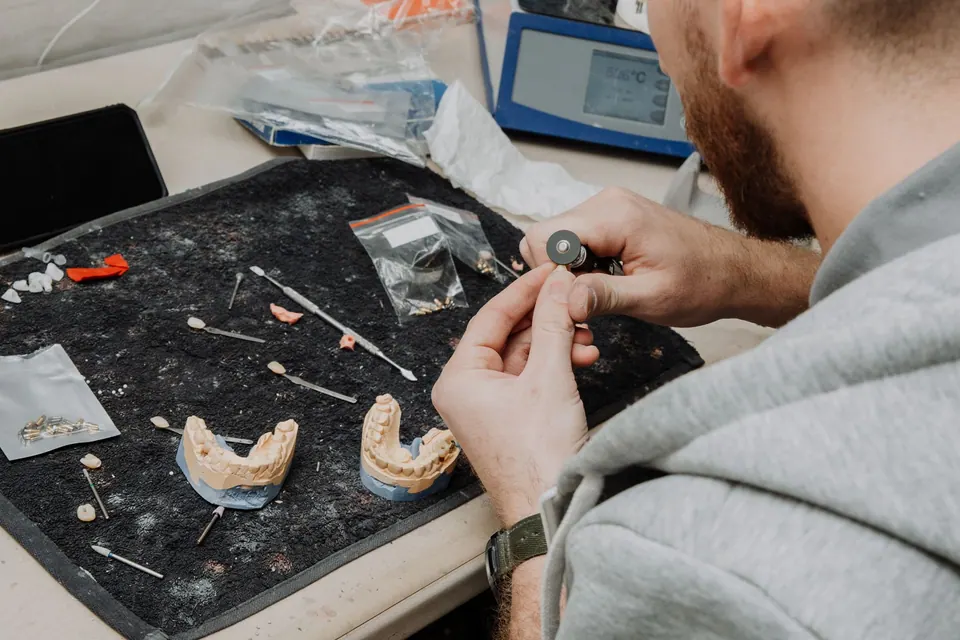
Like any prosthetic solution, a telescopic denture has drawbacks that you should know about before deciding. The supporting teeth must be prepared to receive the primary crowns, and root canal treatment is sometimes needed on a tooth that is strongly tilted or badly damaged. Fabrication requires great precision and several try-in stages, so treatment takes longer than for a simple removable denture.
Over time, the friction between the crowns may decrease slightly; adjustments are then made at check-ups. Finally, a telescopic denture is still removable: it has to be taken out for cleaning, which does not suit everyone. If you would prefer a fully fixed solution, a dental crown on each retained tooth combined with implants can be considered as an alternative.
Telescopic denture or implant-supported denture?
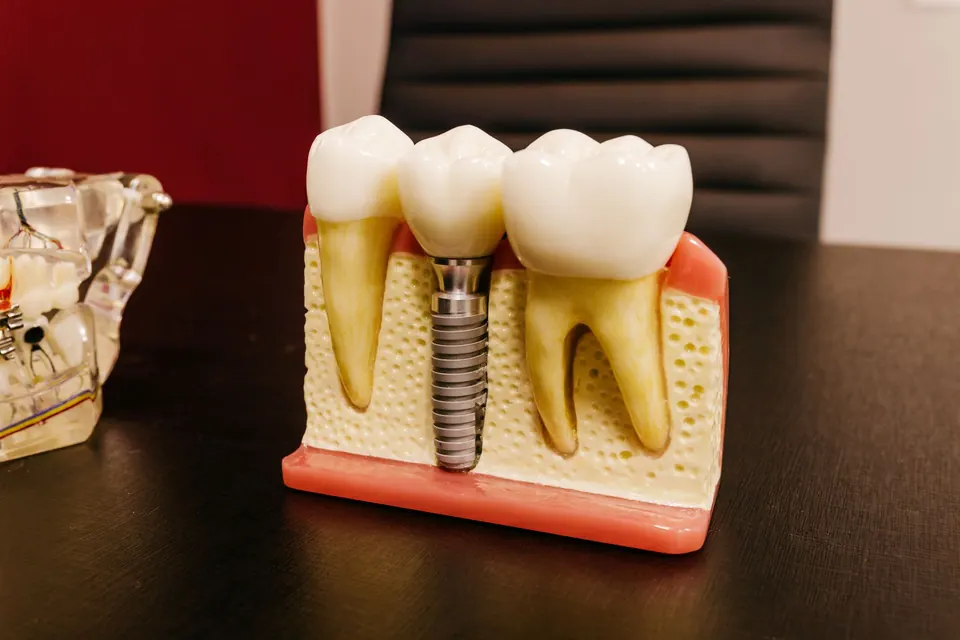
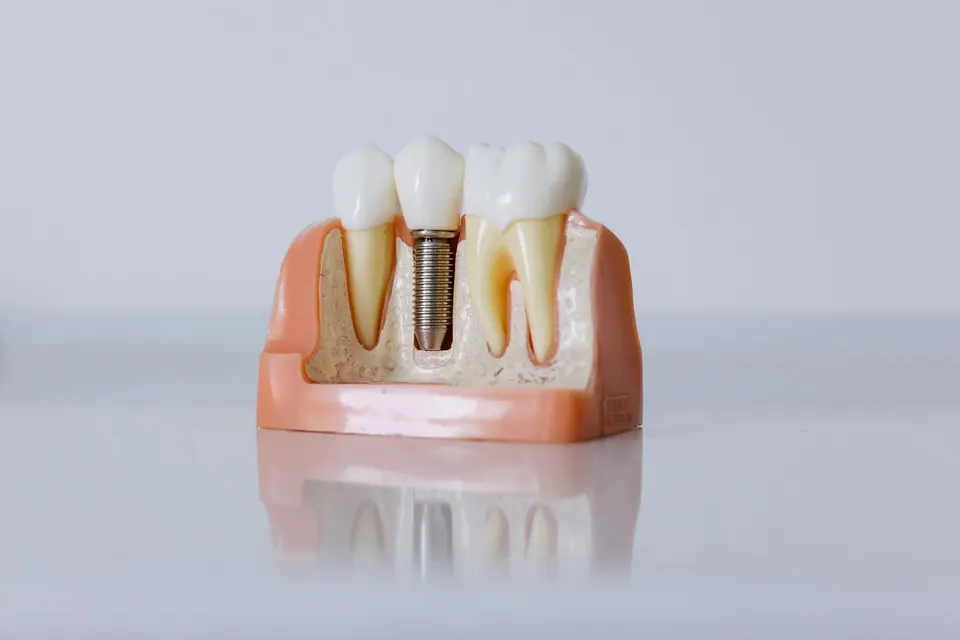
The two approaches are not always alternatives. Where the bone allows, one or more dental implants can carry primary crowns and act as additional supports, which makes the telescopic denture more stable. Conversely, when the remaining natural teeth are strong and well positioned, they may be enough on their own, with no surgery.
The choice depends on the amount of bone, the number and position of your remaining teeth, your general health and your priorities: fixed or removable, how many procedures you are willing to have, and budget. Dr Fenjero explains the possible combinations and what each involves, so that the decision is entirely yours.
Daily care and follow-up
A telescopic denture should be taken out at least once a day for cleaning. Brush the primary crowns that stay in your mouth as you would natural teeth, paying particular attention to the gum line, where plaque builds up. Clean the denture separately with a suitable brush and water, avoiding abrasive products that scratch the friction surfaces.
Check-up visits are used to monitor the health of the supporting teeth and gums, the fit of the denture and your bite. Regular scaling is recommended, because gum inflammation around an abutment tooth can compromise its stability in the long term.
A first consultation to assess your case in Rabat
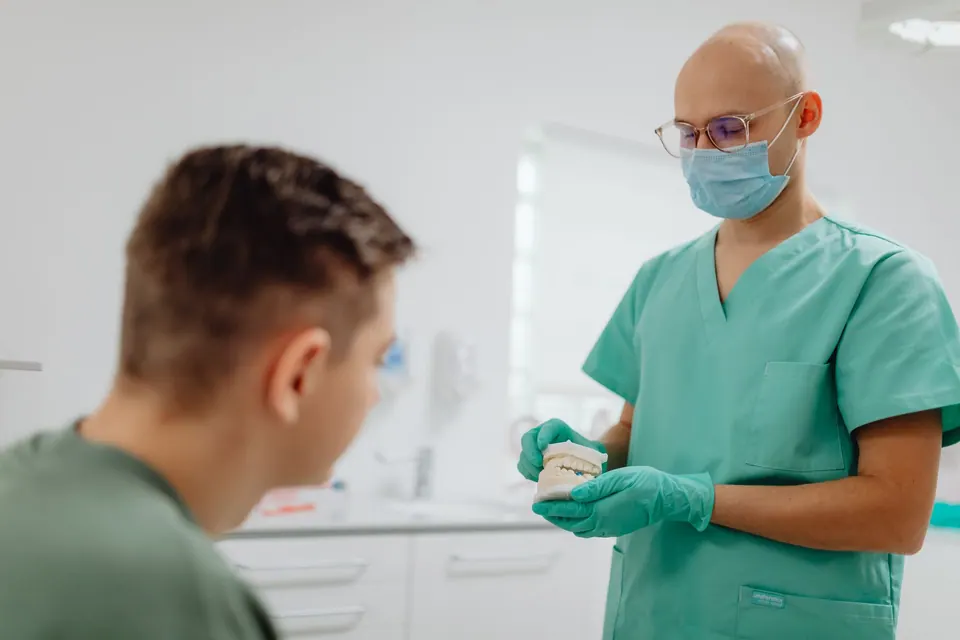
Every telescopic denture is a tailor-made project. At your first appointment at the clinic in Agdal, the dentist examines your remaining teeth, gums and bone, takes the necessary X-rays and explains whether this solution suits your mouth. You receive a treatment plan and a written estimate, with no obligation. You can request an appointment to discuss it.
How it works
- Assessment and treatment planExamination of the remaining teeth, gums and bone, X-rays, then choice of the supporting teeth and presentation of the estimate.
- Restoring oral healthTreatment of decay and gum problems, and any necessary extractions, before work on the denture begins.
- Preparing the supporting teethUnder local anaesthetic, the abutment teeth are prepared and a precise impression is taken.
- Primary crowns and try-insThe primary crowns are tried in, then the denture is set up and adjusted over several stages.
- Fitting the dentureThe primary crowns are cemented and the denture is fitted, with guidance on how to put it in and take it out.
- Adjustments and follow-upCheck-ups are used to relieve pressure points and adjust the friction if needed.
Frequently asked questions
How is it different from a removable denture with clasps?
A conventional partial denture is held by metal clasps around certain teeth, which are often visible when you smile. A telescopic denture is guided by crowns fixed on the supporting teeth: it is more stable, has no visible clasps and transmits forces to the remaining teeth more favourably. In return, those teeth must be prepared and the fabrication work is more meticulous.
Does a telescopic denture stay in place when eating?
Yes, that is one of its main benefits. The friction between the primary and secondary crowns stops the denture from lifting or tipping while you chew. How well it holds does, however, depend on the number and distribution of the supporting teeth, which is assessed at the initial examination.
Should I take the denture out at night?
The advice depends on your situation and is explained to you when the denture is fitted. In every case, the denture must be taken out at least once a day to clean the denture itself, the primary crowns and the gums. This regular cleaning protects the supporting teeth on which the stability of the whole system depends.
What happens if I lose a supporting tooth?
In many cases the denture can be modified: the secondary crown concerned is converted and a prosthetic tooth is added. This ability to adapt is one of the advantages of the system. Whether it is feasible, however, depends on the number of remaining supports and must be assessed case by case.
How much does a telescopic denture cost in Morocco?
The cost depends on the number of supporting teeth, the materials, whether implants are added and any preliminary treatment required. Without an examination, any figure would be approximate and potentially misleading. After the assessment, you receive a detailed written estimate so that you can decide with peace of mind.
Can natural teeth and implants be combined?
Yes. When there are too few remaining teeth or they are poorly distributed, one or more implants can carry primary crowns and act as additional supports. This combination improves the stability of the denture. It requires sufficient bone volume and an assessment of your general health.
The information on this page is general. Only a consultation allows a diagnosis and a suitable treatment plan. Updated on 14 October 2026.