The double-crown principle
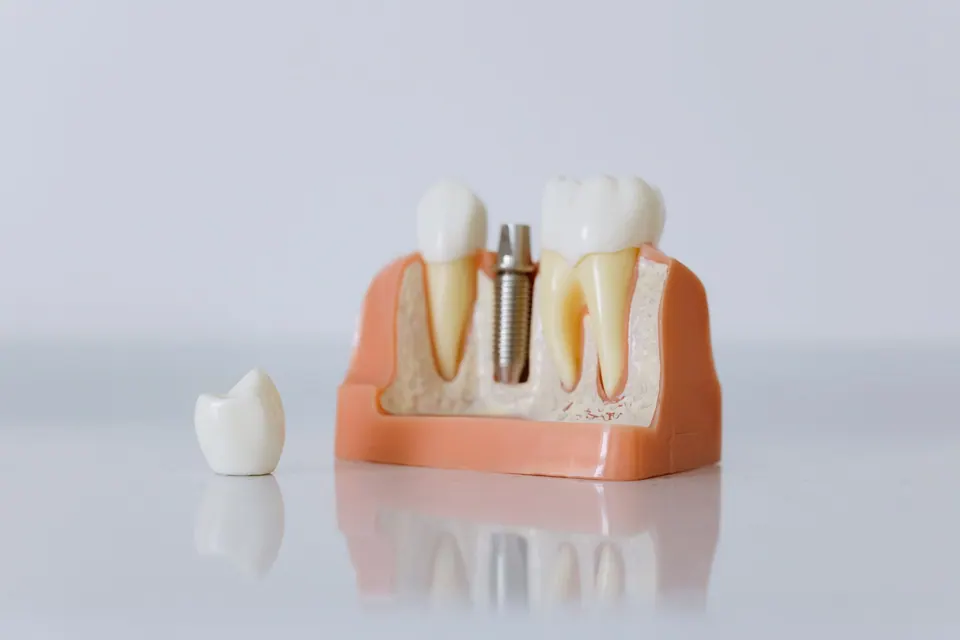
A telescopic denture, also known as a double-crown denture, is based on a simple mechanical principle, inspired by a telescope whose tubes slide into one another.
It has two components:
- primary crowns, thin caps fixed permanently on the remaining teeth or on implants;
- a removable denture containing secondary crowns, which fit exactly over the primary crowns.
When the denture is in place, the very precise fit between the two crowns holds it by friction. The denture stays firmly in place, with no visible metal clasps, and patients can remove it themselves to clean it.
This technique has been widely used and taught in German-speaking countries for many years, where it is one of the standard solutions for combined fixed and removable prosthetics. For a detailed presentation of the treatment, see our telescopic denture page.
Who is it suitable for?
A telescopic denture is mainly intended for people who are missing several teeth but still have a few teeth that can serve as anchors, or who can receive a few implants. It is particularly offered:
- when few teeth remain, unevenly spread along the arch;
- when the remaining teeth have an uncertain long-term outlook;
- when the bone does not allow enough implants for a fully fixed solution, or the patient does not want one;
- when natural teeth and implants are to be combined in the same denture;
- for people who have difficulty with the clasps of a conventional partial denture.
The choice is made after a full assessment: the condition of each anchor tooth, gum health, X-rays and the patient's expectations regarding comfort, appearance and maintenance.
The benefits for the patient
The telescopic denture has several strengths that explain its popularity in the countries where it is widely used:
- Good stability: friction retention limits movement of the denture when chewing and speaking.
- No visible clasps: the appearance is generally better than with a clasp-retained denture.
- Easier hygiene: the denture comes out, so the primary crowns and gums can be cleaned thoroughly, which is important for the health of the anchor teeth.
- Favourable distribution of forces: the crowns transmit forces along the axis of the teeth, which spares the anchors.
- An adaptable denture: if an anchor tooth ever has to be extracted, the denture can often be modified and kept instead of being completely remade.
This adaptability is particularly valued by patients whose remaining teeth are fragile.
Its limits and constraints
Like any solution, the telescopic denture also has constraints that are important to know:
- Preparation of the anchor teeth: they must be shaped to receive the primary crowns, and sometimes need root canal treatment when space is limited.
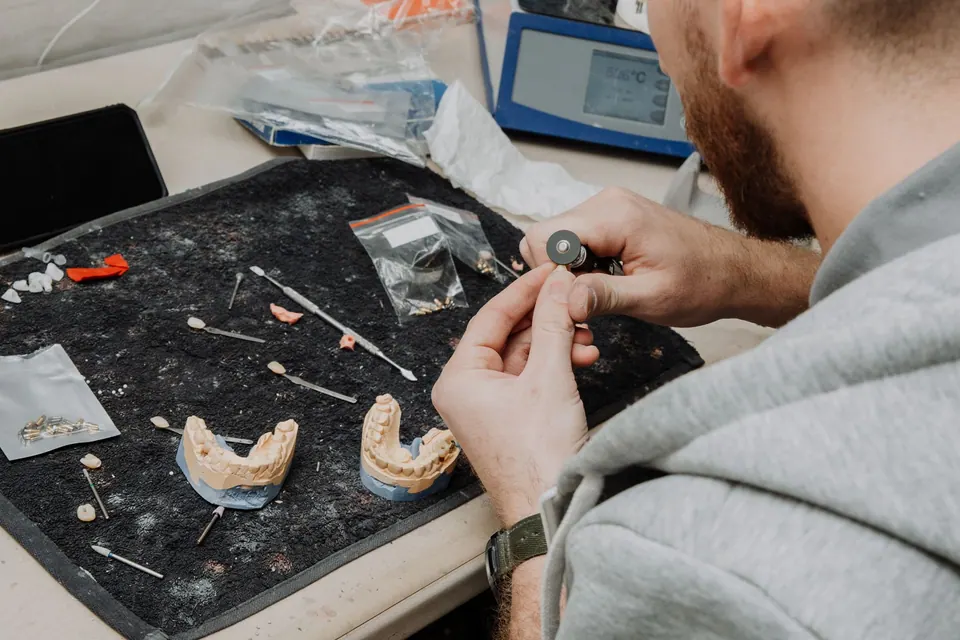
- Demanding fabrication: the precision of the fit requires meticulous laboratory work and several try-in appointments.
- A particular appearance without the denture: when the denture is removed, the primary crowns are visible in the mouth, which can be surprising at first.
- Regular maintenance: over time, the friction may weaken or an anchor tooth may change, which calls for check-ups and sometimes adjustments.
- An investment that is often greater than a conventional partial denture, because of the complexity of fabrication.
The dentist compares these points with the other possible options, such as a bridge, implants or a clasp-retained removable denture.
Natural teeth, implants or both
The primary crowns can be fixed on natural teeth, on dental implants, or on a combination of both. Adding a few implants in areas lacking support helps distribute the load of the denture better and improves its stability.
This approach is useful when the number of implants needed for a fully fixed solution would be high, or when the volume of bone would not allow it without major reconstruction. It offers a balance between stability, cost and surgical complexity.
The anchor teeth must, however, be healthy or properly treated. A damaged tooth can first receive cavity treatment, root canal treatment or a build-up, and a tooth that is too fragile can be replaced by a dental crown included in the plan, or by an implant.
The fabrication stages
Making a telescopic denture involves several stages:
- clinical and radiographic assessment, with prior treatment of any cavities and gum problems;
- preparation of the anchor teeth and impressions, conventional or with an intraoral scanner;
- fabrication and try-in of the primary crowns;
- an impression of the whole arch and recording of the bite;
- try-in of the tooth set-up, to approve the appearance and function;
- cementation of the primary crowns and fitting of the denture;
- fit checks in the following weeks.
German Dental Clinic has digital impression equipment and a milling unit for computer-aided fabrication, which contribute to the precision of certain prosthetic components. The number of sessions depends on the complexity of the case and is specified in your treatment plan.
Living with a telescopic denture
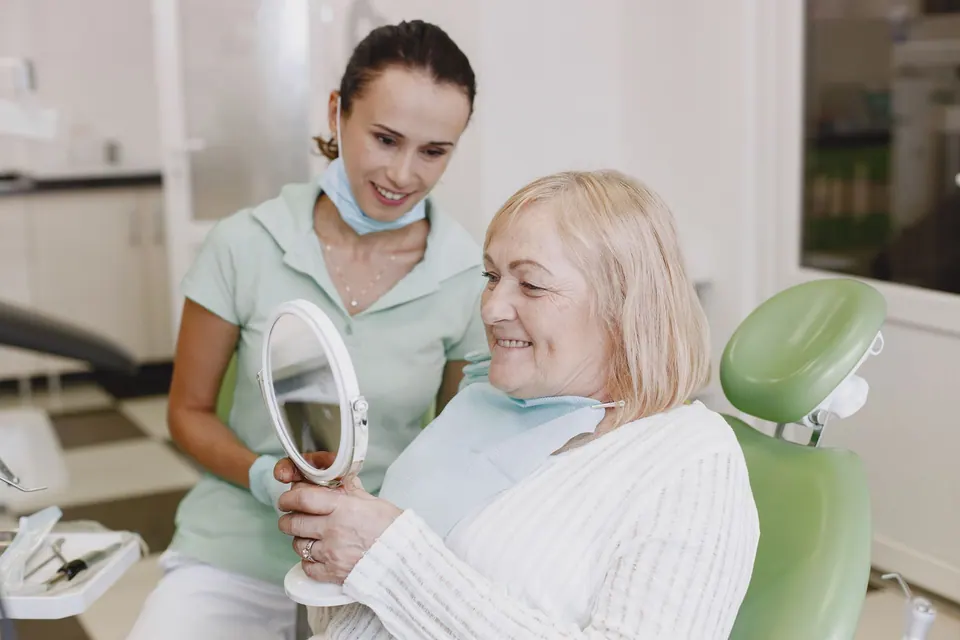
In the first few days, you need to get used to putting the denture in and taking it out, always along the same axis, without forcing it or biting it into place. Speech and chewing usually adapt quickly.
Day to day: take the denture out to clean it after meals, brush the primary crowns and gums carefully, and follow your dentist's advice for the night. Regular check-ups make it possible to monitor the anchor teeth, the friction and the condition of the gums.
If you live in Rabat and have been offered a partial denture, or if your current denture is uncomfortable, you can book an appointment in Agdal to see whether a telescopic solution suits your situation.
Frequently asked questions
Is a telescopic denture fixed or removable?
It is removable: patients can take it out themselves to clean it. But thanks to the precise fit of the double crowns, it is very stable in the mouth, which makes it feel closer to a fixed restoration.
How many teeth are needed for a telescopic denture?
There is no single number. You need sufficiently strong anchors that are well distributed along the arch, whether natural teeth or implants. This is assessed during the examination, taking into account the condition of each tooth and of the bone.
What happens if an anchor tooth has to be extracted?
This is one of the strengths of the technique: in many cases, the denture can be modified to make up for the lost anchor without being completely remade. An implant can sometimes be added to create a new anchor.
Should the denture be removed at night?
Recommendations vary from case to case and your dentist will give you precise instructions. In any event, the denture must be removed regularly for cleaning, along with the primary crowns and the gums.
The information on this page is general. Only a consultation allows a diagnosis and a suitable treatment plan.