Why replace a missing tooth?
A missing tooth is not only a cosmetic issue. Over time, the neighbouring teeth tend to tilt into the gap, and the opposing tooth may drift down or up because it no longer has anything to bite against. Chewing shifts to other areas, which can overload certain teeth and, in some people, the jaw joint.
The bone that used to support the root is no longer stimulated, so it gradually shrinks. This is barely noticeable at first, but it can make a later replacement more complicated. That is why it is worth reviewing the situation fairly soon after an extraction, even if you do not want to act straight away.
Two fixed solutions come up most often in consultations: the dental implant and the bridge. They do not work in the same way and do not suit the same situations.
The bridge: a span resting on the neighbouring teeth
A bridge is a fixed restoration that fills the gap by resting on the teeth on either side. These teeth, called abutments, are prepared (reshaped) to receive crowns, which are joined to an artificial tooth in the middle.
Its strengths:
- no surgery is required;
- treatment is usually completed in a few closely spaced appointments;
- it is a good fit when the neighbouring teeth are already damaged or crowned, since preparing them then also protects them.
Its main drawback lies precisely in preparing the abutments: if those teeth are healthy, intact enamel has to be removed to shape them. Cleaning under the middle tooth also requires specific hygiene (interdental brushes, suitable floss). Finally, a bridge does not slow down bone loss under the toothless area. To find out more, see our dental bridge page.
The implant: an independent artificial root
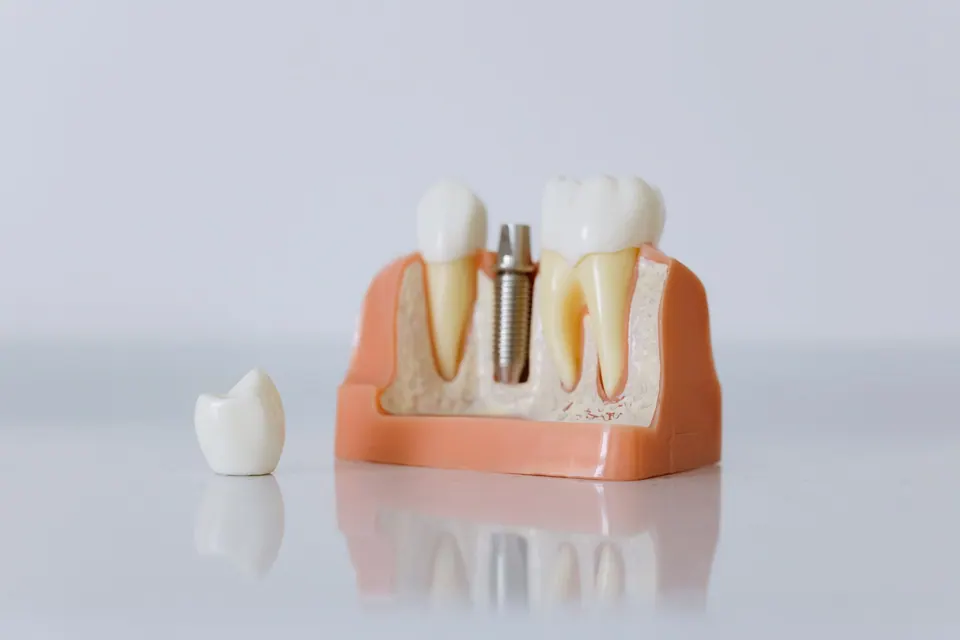
A dental implant is a small titanium (or sometimes ceramic) screw placed in the jawbone. After a healing period during which the bone bonds to its surface, it receives a crown that reproduces the visible tooth.
Its main advantages:
- it leaves the neighbouring teeth untouched;
- it transmits chewing forces to the bone, which helps to stimulate it;
- it is cleaned like a natural tooth, with a toothbrush and floss or interdental brushes.
On the other hand, placement requires a surgical procedure, a healing period and enough bone. Certain medical situations (heavy smoking, poorly controlled diabetes, some bone medications) call for precautions or a specific assessment. Our dental implant page describes each step of the treatment.
The criteria that guide the choice
There is no one-size-fits-all answer. The choice is based on your mouth and your expectations:
- The condition of the neighbouring teeth. If they are healthy, this tends to favour an implant. If they are already weakened or crowned, a bridge can be a sensible option.
- Bone volume. An X-ray examination, sometimes in 3D, measures the available bone. If there is not enough, a bone graft may be suggested before or during implant placement.
- General health. Some conditions and medications affect healing and should be mentioned.
- The number of missing teeth. For several missing teeth, combined solutions exist (an implant-supported bridge, for example).
- Timing and your preferences. A bridge is often quicker to complete, while an implant requires more patience.
These factors are assessed during a consultation, never from a photo alone.
Care and longevity: what really matters
Whether it is an implant or a bridge, how long it lasts depends largely on daily hygiene and follow-up. A bridge can come loose, or an abutment tooth can develop decay under its crown. An implant can be affected by inflammation of the surrounding tissues, known as peri-implantitis, often linked to plaque build-up or smoking.
In both cases, a few simple habits make the difference: careful brushing twice a day, cleaning between the teeth with suitable interdental brushes, regular check-ups and professional scaling. Wearing a night guard may be advised if you clench or grind your teeth at night.
No restoration lasts forever, but one that is well designed and well looked after generally serves the patient for many years.
How is the decision made at the practice?
At the first appointment, the dentist examines the toothless area, the gums and the neighbouring teeth, then takes the necessary X-rays. At German Dental Clinic in Agdal, digital imaging and intraoral scanner impressions make it possible to visualise the situation and explain the possible options clearly.
You then receive a detailed treatment plan with the steps, the estimated timescales and a quote. This is the right moment to ask your questions: number of appointments, how the temporary phase is handled, what care to expect. Taking the time to compare the options with your dentist remains the best way to make a confident choice. While an implant heals, a temporary solution can be provided so that you are not left with a visible gap, especially at the front of the mouth.
If you live in or around Rabat and would like advice about a missing tooth, you can book an appointment for an assessment.
Frequently asked questions
Is an implant always better than a bridge?
No. An implant preserves the neighbouring teeth and stimulates the bone, but it requires surgery and sufficient bone. A bridge remains a sound option when the supporting teeth are already crowned or damaged, or when an implant is not advisable. The choice depends on your clinical situation.
Is having an implant placed painful?
The procedure is carried out under local anaesthesia, which generally makes it comfortable. In the following days, some discomfort, swelling or sensitivity may occur; these are usually well controlled with the prescribed painkillers and the post-operative instructions.
Can a bridge be replaced by an implant later on?
It is sometimes possible, provided there is enough bone in the toothless area. Since bone can shrink over time, a graft may be needed. An X-ray allows this to be assessed case by case.
How long does it take to get the final tooth?
A bridge is usually completed within a few weeks. For an implant, you need to allow for a bone healing phase before the final crown, longer if a graft is required. You are given a precise timeline after the examination.
The information on this page is general. Only a consultation allows a diagnosis and a suitable treatment plan.