How does teeth whitening work?
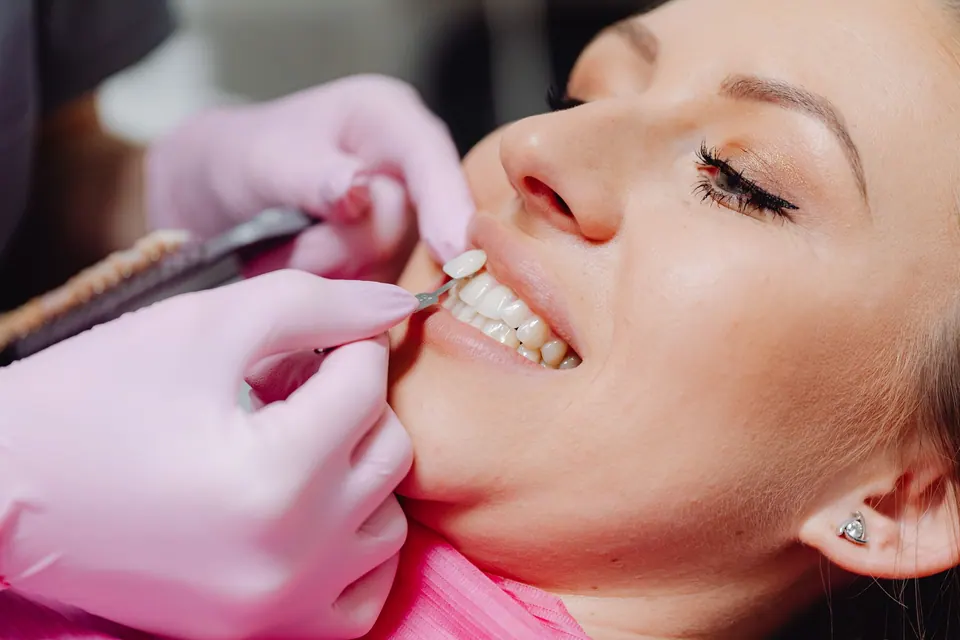
Teeth whitening relies on a chemical principle: a peroxide-based gel (hydrogen or carbamide peroxide) penetrates the enamel and dentine, where it breaks down the pigments that cause discolouration. The tooth becomes lighter from within, without its surface being sanded down.
It should be distinguished from two other procedures that are often confused with it:
- scaling and polishing, which remove tartar and surface stains (tea, coffee, tobacco) and often restore a natural shine;
- so-called whitening toothpastes, which mainly work through mild abrasion or surface agents, with a limited effect on the deeper shade.
Teeth whitening supervised by a dentist can be done in the chair, at home with custom-made trays, or as a combination of both. The choice depends on your teeth, your sensitivity and your practical constraints.
In the practice, the gum is protected by a barrier before the gel is applied, and the dentist controls the contact time. At home, trays made from your impression limit any overflow of the product. In both cases, safety comes less from the product itself than from the supervision: a prior diagnosis, a suitable concentration and monitoring of any reactions.
Sensitivity, the most common side effect
During or after whitening, many patients notice sensitivity to cold, sometimes with brief, sharp twinges that are not serious. It is linked to the gel passing into the dentine and usually disappears a few days after the end of treatment.
To limit it, the dentist can:
- adjust the concentration and application time;
- space out the sessions or the nights the trays are worn;
- recommend a desensitising toothpaste or gel before and during treatment;
- treat exposed tooth necks or small cracks beforehand.
It is important to report any unusual sensitivity. Strong or persistent pain is not normal, and applications should be stopped until you have sought advice.
Gums, decay and restorations: essential checks
Before any whitening, a full examination is necessary. The gel can irritate inflamed gums, and it penetrates more deeply into a damaged tooth. The dentist therefore checks:
- that there is no active decay and no significant cracks;
- the condition of the gums, with scaling if needed;
- existing fillings, crowns and veneers.
This last point is often overlooked: restorations do not whiten. A crown or composite filling on a front tooth keeps its original shade while the natural teeth become lighter. They sometimes need to be replaced after whitening so that the smile looks even. It is better to know this from the start.
Some deep discolouration, for example caused by certain medications taken during childhood or by a root-canal-treated tooth, responds less well and may call for a different approach.
Products bought online: be careful
LED kits, charcoal powders, whitening strips, gels of unknown origin: the online offer is plentiful and tempting. The risk does not necessarily come from the active ingredient, but from the lack of supervision:
- an uncontrolled or poorly labelled concentration;
- one-size-fits-all trays that let the gel spill onto the gums;
- use on undiagnosed decay or diseased gums;
- abrasive products (charcoal, excessive bicarbonate) that wear away enamel with each brushing.
Home remedies such as lemon or vinegar are best avoided: their acidity attacks the enamel and can eventually make teeth look more yellow, since the underlying dentine is naturally darker.
If you have any doubt about a product, it is better to ask your dentist before using it.
Who should avoid or postpone whitening?
Whitening is not suitable for everyone, nor at any time. It is generally advised against or postponed:
- during pregnancy and breastfeeding, as a precaution;
- in children and teenagers, whose teeth are still maturing;
- in the presence of untreated decay, gum disease or very sensitive teeth;
- in case of a known allergy to the components of the gel.
Expectations also need to be realistic. Results vary from one person to another depending on the starting shade and the type of discolouration. The dentist cannot promise a precise shade, but can explain what is reasonably achievable for your teeth.
After whitening: preserving the result
In the days that follow, the teeth absorb pigments more easily. It is advisable to temporarily cut down on coffee, tea, coloured soft drinks, strong spices and tobacco. A straw can help with some drinks.
In the longer term, the result fades gradually depending on your diet and habits. Regular brushing, periodic scaling and, if your dentist considers it useful, short top-up sessions with your trays help it last longer.
If your goal goes beyond colour alone (shape, alignment, damaged teeth), other solutions such as dental veneers can be discussed during a cosmetic assessment.
Supervised whitening in Rabat
Successful whitening starts with a consultation: an examination, photos of the starting shade, and an explanation of the options and precautions suited to your case. At German Dental Clinic in Agdal, this step also helps identify any restorations that will need replacing and build a coherent plan rather than a one-off procedure.
Do you live in Rabat, Salé or Témara and are you thinking of brightening your smile? You can book an appointment for an initial assessment.
Frequently asked questions
Does whitening damage enamel?
When carried out with suitable products under a dentist's supervision, whitening is not considered harmful to enamel. The risks mainly come from overuse, abrasive or acidic products and application on teeth that have not been examined.
Will my crowns whiten too?
No. Crowns, veneers and composite fillings keep their original shade. If they are on visible teeth, they may need to be redone after whitening to achieve an even colour.
Is sensitivity after whitening normal?
Mild, temporary sensitivity is common and usually disappears within a few days. Intense or lasting pain is not normal: stop the applications and contact your dentist.
How long does the result last?
There is no fixed duration. The result fades gradually depending on diet, smoking and hygiene. Occasional top-ups, agreed with your dentist, help it last longer.
The information on this page is general. Only a consultation allows a diagnosis and a suitable treatment plan.