Two restorations that are often confused
When people want to improve their smile, the words veneer and crown come up often, sometimes as if they meant the same thing. Yet they describe two different approaches.
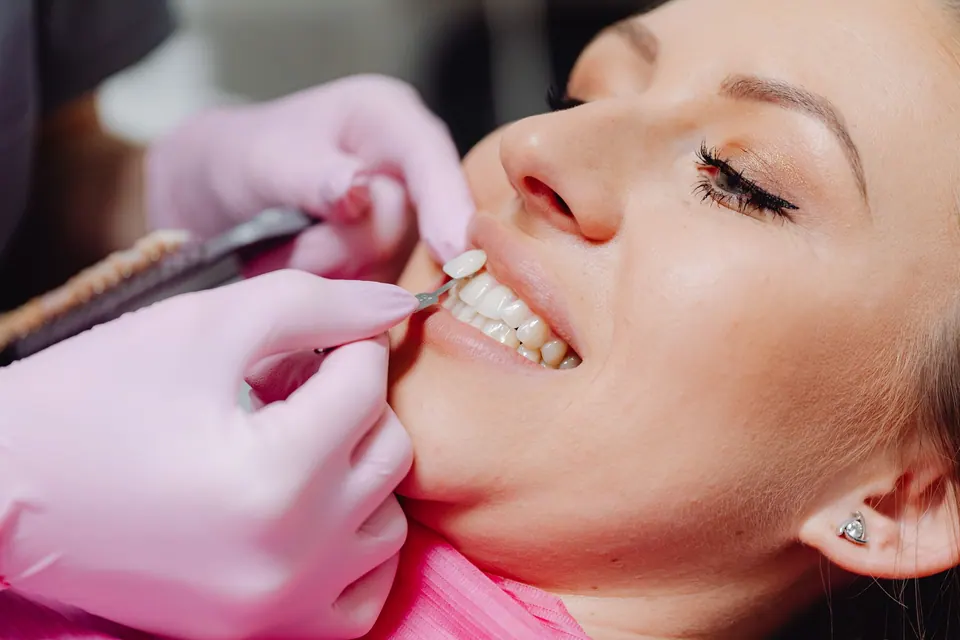
A veneer is a thin shell, most often made of ceramic, bonded to the visible front surface of the tooth. It changes the shade, shape or length of the tooth while keeping most of its structure.
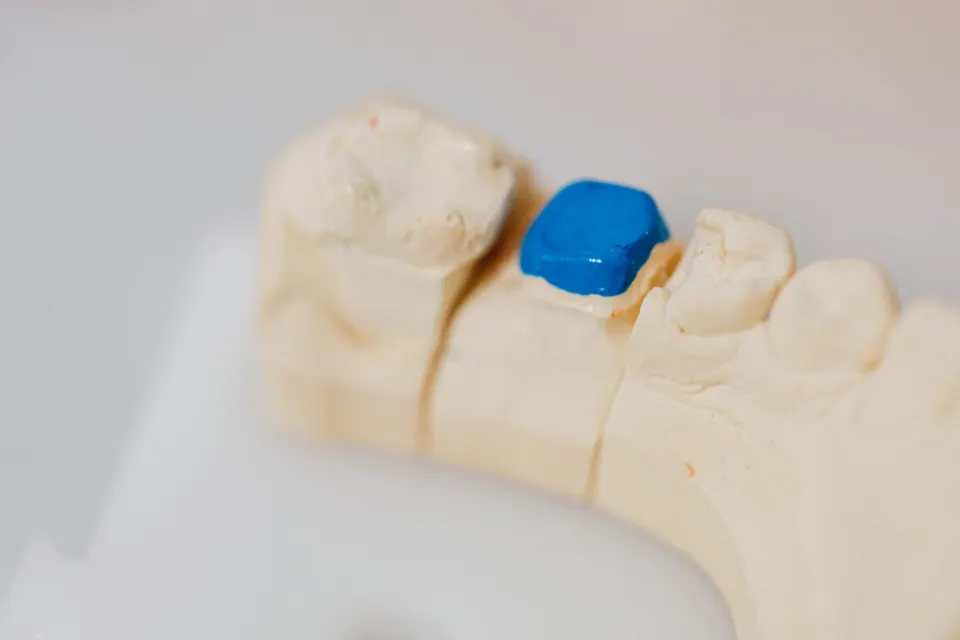
A crown is a cap that covers the tooth on all sides. It replaces the visible part of the tooth when it is too damaged to be repaired in any other way, restoring its strength and shape.
In short, a veneer mainly changes the appearance of a tooth that is broadly healthy, whereas a crown first meets a need for protection and rebuilding. Both can give a very natural result when they are well designed.
When is a veneer appropriate?
Dental veneers are mainly used on the front teeth, the ones that show when you smile. They may be suggested for:
- discolouration that does not respond to whitening;
- teeth that are slightly worn, chipped along an edge or irregular in shape;
- small gaps between teeth;
- minor alignment issues, when orthodontics is not wanted or not needed.
Preparation is usually limited to a thin layer of enamel and, in some situations, it can be minimal. It is important to know, however, that a tooth prepared for a veneer will not return to its original state: this is a carefully considered decision.
Veneers require a reasonably healthy tooth and enough enamel for a lasting bond. They are less suitable where there are large existing fillings or significant, uncontrolled bruxism.
When is a crown the better option?
A dental crown becomes the logical solution when a tooth has lost a large part of its structure. It is suggested in particular:
- after root canal treatment, especially on molars and premolars, which become more brittle;
- when there is large decay or an old, extensive filling;
- after a significant fracture;
- on an implant, to replace the visible part of the tooth;
- as the support for a bridge.
Preparation is more extensive than for a veneer, since the crown surrounds the whole tooth. In return, it protects the tooth against fractures and spreads chewing forces better. Modern materials (ceramic, zirconia) make it possible to achieve a look close to that of a natural tooth, even at the front of the mouth.
Comparing the two options point by point
To make things clearer, here are the main differences:
- Tooth preservation: a veneer is more conservative; a crown requires reducing the tooth all the way round.
- Main purpose: appearance for a veneer; rebuilding and protection for a crown.
- Area of the mouth: veneers are mainly for the front teeth; crowns can be placed anywhere.
- Strength: a crown copes better with heavy loads, especially on the molars.
- Care: in both cases, brushing, floss or interdental brushes and regular check-ups. Biting hard objects should be avoided.
Some treatment plans actually combine both: veneers on healthy teeth and crowns on more fragile ones, harmonised within a single cosmetic plan.
The value of an overall cosmetic plan
A single veneer or crown has to blend in with the neighbouring teeth, the gum and the face. When several teeth are involved, a smile design approach helps define the shape, length and shade, taking into account your lips, your smile line and your wishes.
In many cases, a temporary try-in lets you see the result in your mouth before any final preparation. This is an ideal moment to fine-tune the plan with your dentist. Photos, a digital impression with the intraoral scanner and, where possible, computer-aided manufacturing all contribute to an accurate result.
Before discussing appearance, the dentist always checks that the gums are healthy and that there is no decay: a restoration placed on a weak foundation would be compromised.
Living with a veneer or a crown
Once fitted, veneers and crowns are brushed just like natural teeth. Ceramic does not decay, but the tooth underneath remains living tissue where it meets the restoration: this is where plaque must be carefully removed every day.
A few habits protect your investment:
- use a soft toothbrush and a low-abrasion toothpaste;
- clean between the teeth with floss or suitable interdental brushes;
- avoid opening packaging or biting hard objects with your front teeth;
- mention any clenching or grinding, for which a night guard may be suggested;
- keep up regular check-ups and professional scaling.
Over time, the gum may recede slightly and reveal the edge of an older restoration. This is not an emergency, but it is something your dentist monitors at each visit.
Making the right choice with your dentist
Choosing between a veneer and a crown is not done from a catalogue. It is based on examining each tooth, recent X-rays and a discussion of your expectations. A healthy but stained tooth and a weakened tooth that has had a root canal do not call for the same answer, even if they sit side by side.
Feel free to ask why a particular option is suggested for a particular tooth, what the preparation involves and what care will be needed. A clear plan, with its steps and its estimate, lets you decide with confidence.
For personalised advice, the German Dental Clinic team welcomes you in Agdal, in the heart of Rabat. You can book an appointment for a cosmetic and functional assessment.
Frequently asked questions
Do veneers damage your teeth?
They usually require light preparation of the enamel, which is irreversible. When they are appropriately indicated and well bonded, they protect the visible surface of the tooth. The dentist assesses whether the preparation is justified by the result you are looking for.
Can a veneer be placed on a root-canal-treated tooth?
It is sometimes possible, but a tooth that has had root canal treatment is often more fragile and may have changed colour. Depending on how much tooth tissue remains, a crown may be better suited to protect it. The choice is made after an examination and an X-ray.
Will people be able to see my crown?
With today's ceramics and zirconia, a well-made crown blends in with the neighbouring teeth in shade and shape. The result also depends on the condition of the gum and the accuracy of the impression.
The information on this page is general. Only a consultation allows a diagnosis and a suitable treatment plan.