Late arrivals that often lack space
Wisdom teeth, or third molars, are the last teeth to come through, usually in the late teens or early adulthood. Some people have four, others fewer, and some none at all.
Because they arrive last, they often find a jaw where the space is already taken. Several situations are then possible:
- the tooth erupts normally and finds its place;
- it only partly erupts, remaining partly covered by the gum;
- it stays impacted in the bone, lying flat or tilted against the neighbouring tooth;
- it erupts but in a poor position that is hard to clean.
It is the position of the tooth and its consequences, rather than its mere presence, that determine whether treatment is needed. Hence the importance of an individual assessment rather than a general rule.
Signs that should alert you
Some symptoms are often linked to wisdom teeth and deserve an examination:
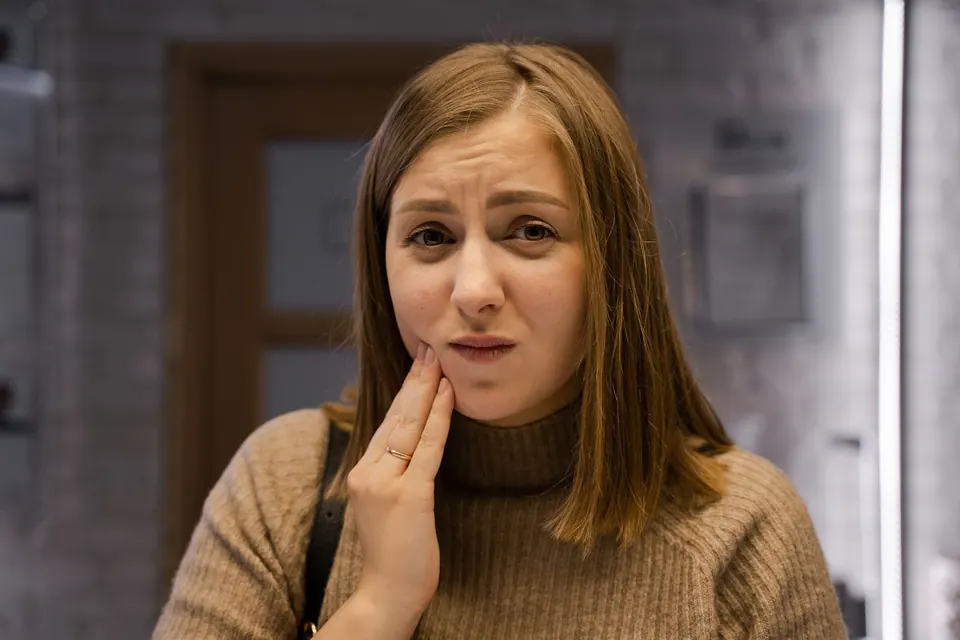
- pain at the back of the mouth, sometimes spreading to the ear or throat;
- swollen, painful gum behind the last molar;
- difficulty opening the mouth or swallowing;
- a bad taste or localised bad breath;
- food regularly getting stuck in the area;
- a swollen cheek, possibly with fever.
Infection of the gum covering a tooth that is erupting is called pericoronitis. It can recur and, in some cases, spread to the surrounding tissues. Significant swelling, fever or difficulty swallowing call for a prompt consultation.
When is extraction advisable?
Extraction is generally recommended when the wisdom tooth is causing a problem, or carries a high risk of doing so. Common situations include:
- repeated episodes of pericoronitis;
- decay in the wisdom tooth itself, difficult to treat because it is hard to reach;
- decay or resorption on the back surface of the second molar, caused by the wisdom tooth pressing against it;
- a gum pocket between the two teeth;
- a cyst or lesion visible on the X-ray around an impacted tooth;
- a tooth with no opposing tooth that interferes with chewing or injures the cheek;
- in some cases, planning for orthodontic or prosthetic treatment.
The decision is made after a clinical and radiographic examination, weighing the expected benefits against the risks of the procedure.
When can they be kept?
A wisdom tooth that has fully erupted, functions well, is healthy and that you can clean properly has no reason to be removed. Likewise, a tooth fully impacted in the bone, with no symptoms or visible lesion, can sometimes simply be monitored with periodic X-rays, especially when removing it would carry more risks than benefits.
Routine removal of healthy wisdom teeth is no longer a generally recommended practice. Each case is discussed individually.
It is worth bearing in mind, however, that surgery is often simpler in young adults, when the roots are not yet fully formed and the bone is more flexible. For a tooth that is causing problems, or is expected to, the dentist may therefore suggest not waiting too long.
X-ray examination: a key step
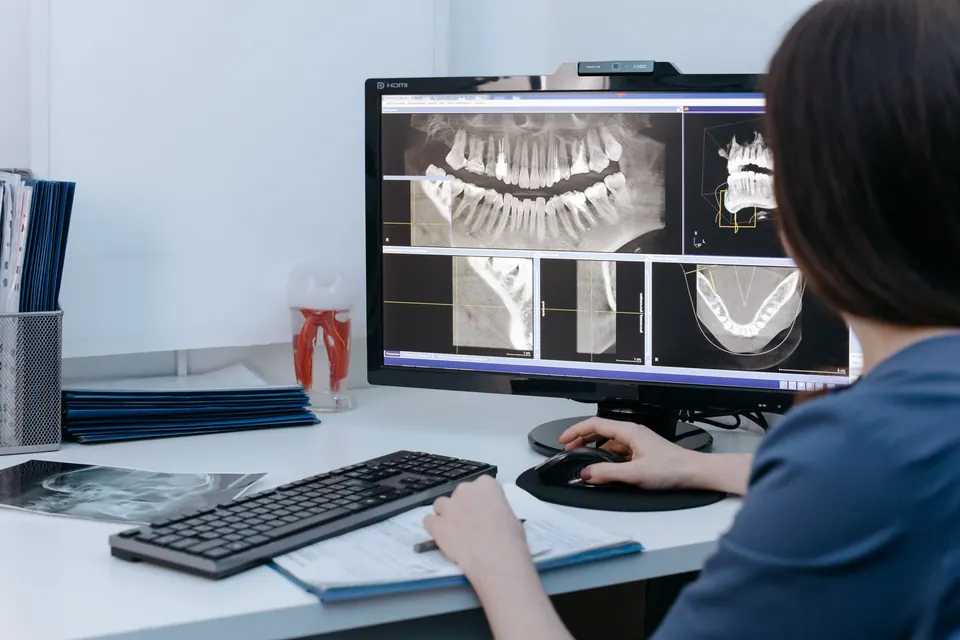
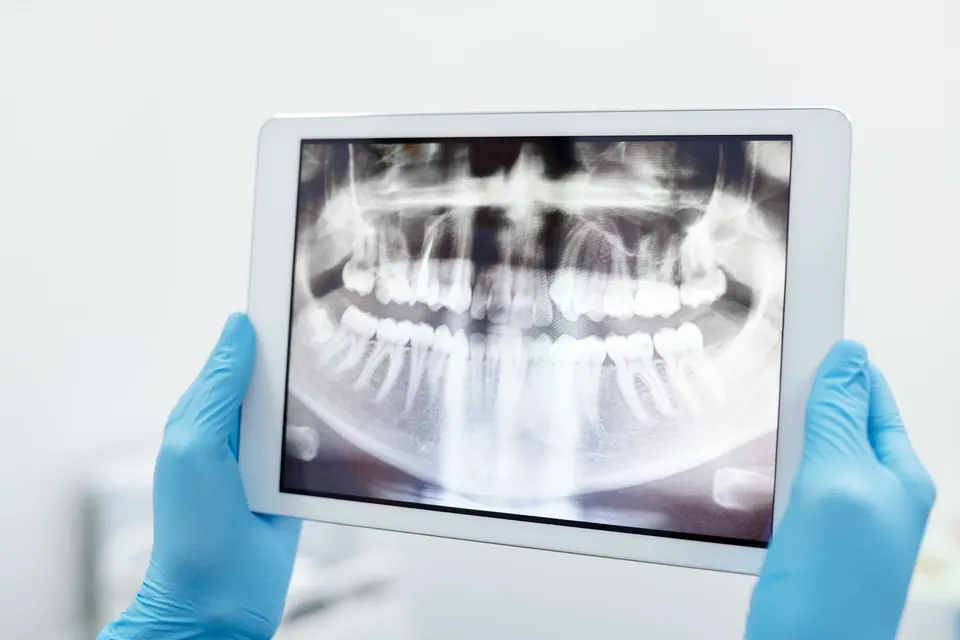
A panoramic X-ray gives an overview of both jaws. It shows the position of each wisdom tooth, the shape of its roots, its relationship with the neighbouring tooth and, for the lower teeth, with the nerve that provides sensation to the lower lip and chin.
When the roots appear very close to this nerve, or to the sinus cavity for the upper teeth, a three-dimensional scan may be requested. It helps the dentist plan the procedure and explain precisely the risks specific to your case.
This step shapes everything that follows: a tooth that is simple to extract and a deeply impacted tooth are not prepared for in the same way.
How the extraction is carried out
Wisdom tooth removal is most often performed under local anaesthetic, in the practice. For an erupted tooth, the procedure resembles a standard tooth extraction. For an impacted tooth, the dentist opens the gum, sometimes removes a little bone and may divide the tooth into several pieces so it can be removed more gently. A few stitches close the gum.
The dentist will tell you whether it is better to remove one, two or all four teeth in the same session, depending on their position, your health and your preference.
Before the procedure, let the dentist know about all your medication, particularly blood thinners, and your medical history. This information may change how the procedure is prepared.
Recovery and good habits
After a wisdom tooth extraction, it is usual to experience for a few days:
- moderate pain, relieved by the prescribed painkillers;
- swelling of the cheek, which often peaks on the second or third day;
- somewhat limited mouth opening;
- sometimes bruising on the cheek.
To help healing: apply something cold to the cheek in the first few hours, avoid spitting, smoking and drinking through a straw, eat soft, lukewarm food, resume gentle brushing the next day while avoiding the wound, and use the prescribed mouthwash. Pain that worsens after a few days, fever or persistent bleeding mean you should contact the practice again.
Oral surgery is one of the areas of care at German Dental Clinic in Agdal. To have your wisdom teeth assessed in Rabat, you can book an appointment.
Frequently asked questions
Should wisdom teeth be removed to stop the front teeth from crowding?
This link has not been clearly established. Crowding of the front teeth with age has several causes, and removing wisdom teeth for this reason alone is not routinely recommended. Your dentist or orthodontist assesses this case by case.
Is wisdom tooth extraction painful?
The procedure is carried out under local anaesthetic, so you should not feel pain during it, only pressure. Afterwards there is often discomfort and swelling for a few days, controlled by the prescribed treatment.
How much time off should I plan after the extraction?
It depends on how difficult the extraction is and on your activities. Many patients plan a few days of relative rest, especially for impacted teeth. The dentist will give you guidance suited to your case at the pre-operative consultation.
The information on this page is general. Only a consultation allows a diagnosis and a suitable treatment plan.